

Description
Deep Learning: GANs and Variational Autoencoders
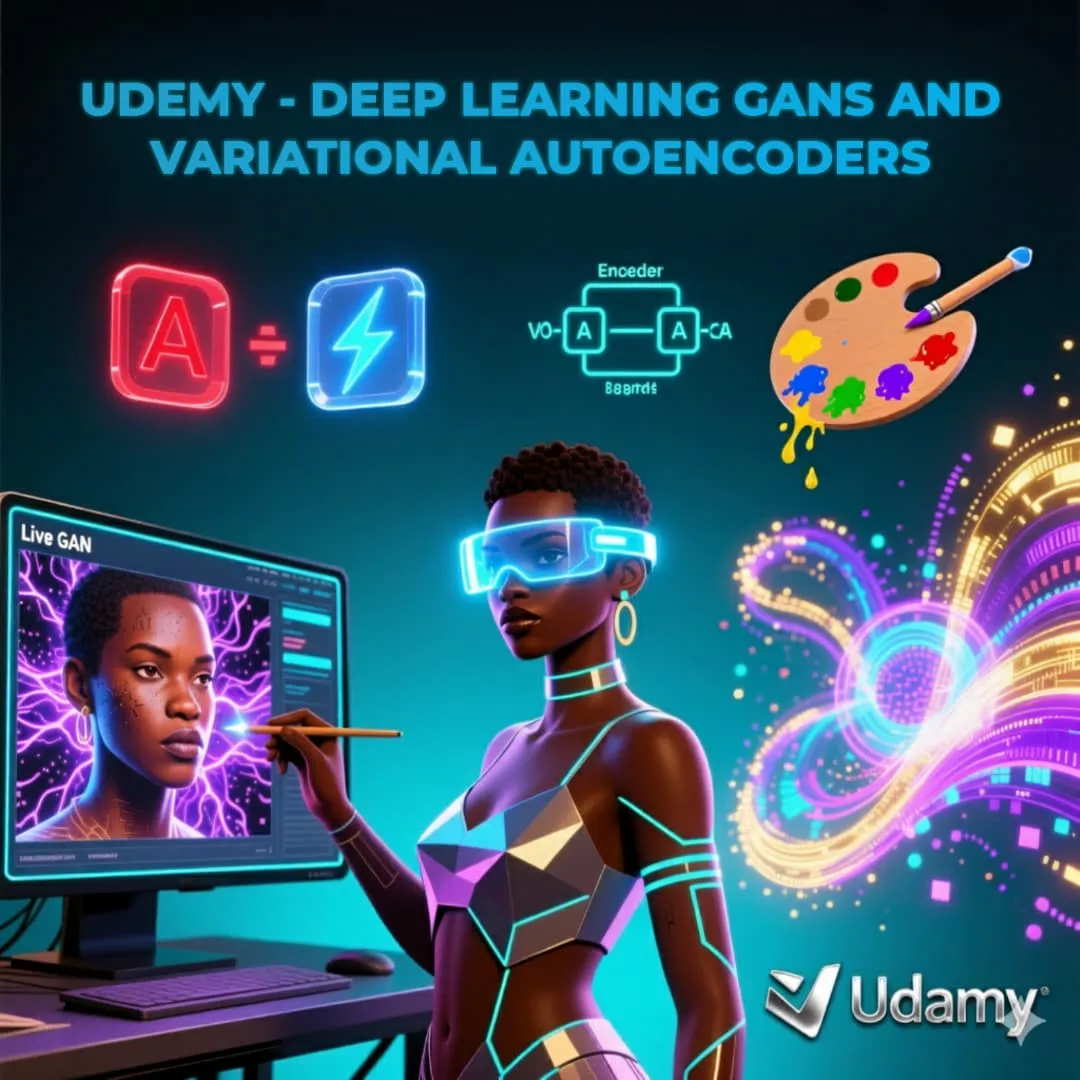
Generative AI is transforming entertainment, design, and science. In this course, you’ll build two of the most powerful generative models: **Generative Adversarial Networks (GANs)** and **Variational Autoencoders (VAEs)**—from theory to implementation in TensorFlow and PyTorch.
Projects You’ll Build
- A GAN that generates new human faces (like ThisPersonDoesNotExist)
- A VAE that learns a compressed latent space of fashion images
- An age progression GAN that turns young faces into elderly ones
- A denoising autoencoder that cleans corrupted images
Key Concepts Covered
- GAN architecture—generator vs. discriminator, adversarial training
- VAE theory—probabilistic encoder, reparameterization trick, KL divergence
- Training tricks—label smoothing, spectral normalization, Wasserstein loss
- Evaluation metrics—Inception Score, FID, visual inspection
- Advanced variants—DCGAN, cGAN, InfoGAN, β-VAE
Why Generative Models?
- Data augmentation—generate synthetic training data
- Art and design—AI-generated fashion, music, and visuals
- Anomaly detection—VAEs identify outliers by reconstruction error
- Foundation for diffusion models—understand the evolution of generative AI
Who Should Take This?
- Deep learning enthusiasts wanting to go beyond classification
- Computer vision engineers exploring generative applications
- Students building advanced capstone projects
- Researchers needing a practical intro to generative modeling
From Pixels to Imagination
You’ll graduate with the ability to **create**, not just classify—unlocking a new dimension of AI.
Ready to make AI that creates? Enroll now.